Badrinath


Badrinath is a Hindu heavenly town and a Nagar panchayat in the Chamoli region in the territory of Uttarakhand, India. It is one of the four locales in India's Char Dham journey and is additionally essential for India's Chota Char Dham journey circuit. It gets its name from the Badrinath Temple.
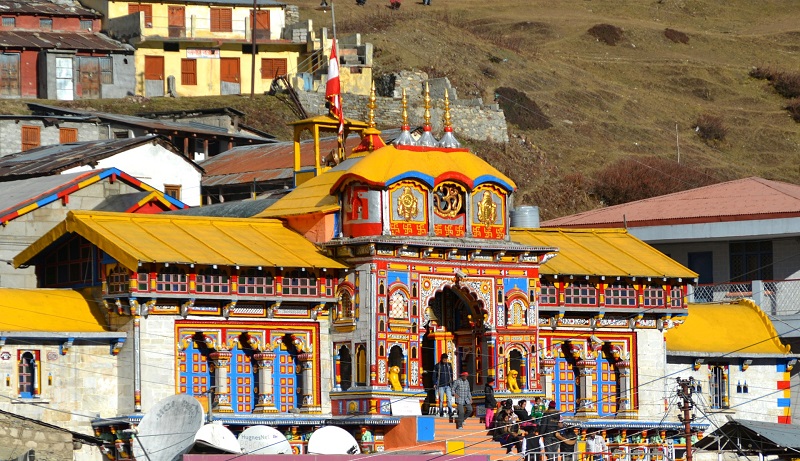
The Badrinath sanctuary is the primary fascination in the town. As per legend, Shankar found a dark stone picture of Lord Badrinarayan made of Shaligram stone in the Alaknanda River. He initially cherished it in a cavern close to the Tapt Kund hot springs. In the sixteenth century, the King of Garhwal moved the murti to the present temple. The sanctuary is roughly 50 ft (15 m) tall with a little vault on top, covered with a gold overlaid roof. The exterior is worked of stone, with curved windows. A wide flight of stairs paves the way to a tall angled entryway, which is the fundamental entry. The design takes after a Buddhist vihara (sanctuary), with the brilliantly painted veneer additionally more commonplace of Buddhist temples. Just inside is the mandapa, an enormous pillared lobby that prompts the garbha grha, or principal place of worship region. The dividers and mainstays of the mandapa are covered with unpredictable cutting.
The Badrinath region is alluded to as Badari or Badarikaashram (बदरिकाश्रम) in Hindu sacred writings. It is a spot consecrated to Vishnu, especially in Vishnu's double type of Nara-Narayana. Along these lines, in the Mahabharata, Krishna, tending to Arjuna, says, "Thou wast Nara in a previous body, and, with Narayana for thy friend, didst perform appalling somberness at Badari for some hordes of years.
One rumor from far and wide suggests that when the goddess Ganga was mentioned to plummet to earth to help to endure humankind on the solicitation of Suryavanshi ruler Bhagiratha, the earth couldn't endure the power of her plunge. Thusly, the powerful Ganga (Ganges) was parted into two sacred channels, with Alaknanda one of them.
Another legend clarifies both name and sitting stance as this spot was brimming with Badri shrubs and Vishnu contemplating for, darling Lakshmi remained close to him protecting him from searing daylight transformed into a Badri herself called 'BADRI VISHAL' and her master (Nath) turned into the Badrinath.
The mountains around Badrinath are referenced in the Mahabharata when the Pandavas were said to have lapsed individually when climbing the slants of a top in western Garhwal called Swargarohini (exacting importance - the 'Rising to Heaven'). The Pandavas went through Badrinath and the town of Mana, 4 km north of Badrinath, en route to Svarga (paradise). There is likewise a cavern in Mana where Vyasa, as per legend, composed the Mahabharata.
The region around Badrinath was praised in Padma Purana as having large amounts of otherworldly fortunes.
This spot is viewed as blessed in Jainism also. In Jainism, Himalaya is likewise called Ashtapad on account of its eight distinct mountain range Gaurishankar, Kailash, Badrinath, Nanda, Drongiri, Nara-Narayana, and Trishuli. Rishabhanatha achieved Nirvana on Mount Kailash arranged in the Himalayan reach and as indicated by Jain confidence (Nirvankand), from Badrinath various Jain Muni got Moksha by doing Tapasya. As indicated by Shrimadbhagwat, at this spot Rishabhdev's dad Nabhirai and mother Marudevi had done hard Tapa after Rishabhdev's Rajyabhishek and taken Samadhi. Indeed, even today impression of Nabhirai at Neelkanth mountain draws in everyone towards him.